The Law of Moses Versus The Law of The Spirit
- robertwsmith480
- Feb 6
- 69 min read
Updated: May 26
The Law of Moses Versus The Law of The Spirit – Part 1-3
By: Mike V
Introduction
It was the night of His apprehension by the Jews that Christ revealed to us that His original 12 apostles were not yet converted.
Luk 22:31 And the Lord said, Simon, Simon, behold, Satan hath desired to have you, that he may sift you as wheat:Luk 22:32 But I have prayed for thee, that thy faith fail not: and when thou art converted, strengthen thy brethren.
They had been with him for three and a half years. They had been given the gifts of healing and casting out devils. They had witnessed men who were born lame walk, and men who were born blind see. They had fed thousands with just a few loaves and fishes. They had witnessed the Lord walking on the water and commanding the wind and the sea to be calm, and they had witnessed Christ raising the 12-year old girl and Lazarus from the dead. Christ’s original 12 apostles, as types of us, “came behind in no gift [and they] were yet carnal… babes in Christ” (1Co 1:7, 1Co 3:1-4).
Then after three and a half years of being spoon fed the basic doctrines of Christ, the Lord was betrayed by one of his own very closest associates. He was rejected and crucified by “His own”, who insisted that the Roman authorities carry out His crucifixion.
Act 3:13 The God of Abraham, and of Isaac, and of Jacob, the God of our fathers, hath glorified his Son Jesus; whom ye delivered up, and denied him in the presence of Pilate, when he was determined to let him go.Act 3:14 But ye denied the Holy One and the Just, and desired a murderer to be granted unto you;Act 3:15 And killed the Prince of life, whom God hath raised from the dead; whereof we are witnesses.
Fifty days after His death and resurrection, the holy spirit was given to 120 people who had remained faithful to the man who had died for their sins. The day of Pentecost was just the beginning of their conversion. There was still much for these new converts to learn about why the Lord had “broken the law” of Moses by healing a man and telling him to “take up [his] bed and walk… on the sabbath day.”
Joh 5:18 Therefore the Jews sought the more to kill him, because he not only had broken the sabbath, but said also that God was his Father, making himself equal with God.
They still did not understand why their Lord had taken the time to speak to the Samaritan woman at the well and then spent two days teaching the Samaritans who had responded to that woman’s witness of “a man who told me all I ever did.”
Joh 4:25 The woman saith unto him, I know that Messias cometh, which is called Christ: when he is come, he will tell us all things.Joh 4:26 Jesus saith unto her, I that speak unto thee am he.Joh 4:27 And upon this came his disciples, and marvelled that he talked with the woman: yet no man said, What seekest thou? or, Why talkest thou with her?Joh 4:28 The woman then left her waterpot, and went her way into the city, and saith to the men,Joh 4:29 Come, see a man, which told me all things that ever I did: is not this the Christ?Joh 4:30 Then they went out of the city, and came unto him.Joh 4:39 And many of the Samaritans of that city believed on him for the saying of the woman, which testified, He told me all that ever I did.Joh 4:40 So when the Samaritans were come unto him, they besought him that he would tarry with them: and he abode there two days.Joh 4:41 And many more believed because of his own word;
This mystery of why Christ would speak to anyone who was not a Jew troubled the very apostles of Christ for many years to come. It is after Stephen was martyred, after Saul of Tarsus was converted and after Peter was sent to the house of the Gentile Roman centurion that we are told the disciples “travelled as far as Phenice and Cyprus, and [Syrian] Antioch preaching the Word to none but to the Jews only” (Act 11:19):
Act 11:19 Now they which were scattered abroad upon the persecution that arose about Stephen travelled as far as Phenice, and Cyprus, and Antioch, preaching the word to none but unto the Jews only.
In our time we might think it strange that the apostles and the whole Jewish Christian church were still ‘marveling that Christ had talked with a Samaritan’ even after Peter had been sent by the holy spirit to the house of another Gentile named Cornelius, a Roman centurion in Caesarea. The whole Jewish Christian church struggled to accept the truth that the law of Moses was being “done away” and replaced with “a better hope, a better testament and a better covenant established on better promises.”
Heb 7:19 For the law [of Moses] made nothing perfect, but the bringing in of a better hope did; by the which we draw nigh unto God.Heb 7:22 By so much was Jesus made a surety of a better testament.Heb 8:6 But now hath he obtained a more excellent ministry, by how much also he is the mediator of a better covenant, which was established upon better promises.2Co 3:7 But if the ministration of death, written and engraven in stones, was glorious, so that the children of Israel could not stedfastly behold the face of Moses for the glory of his countenance; which glory was to be done away:
That struggle continues until this very day throughout the entire Christian church which still believes that the Lord regards Abraham’s physical descendants to be “the Israel of God” and that the Lord will bless those who bless physical Israel and curse those who curse physical Israel. That false doctrine has been the basis of the foreign policy of the United States ever since before the establishment of the state of Israel, which still denies their own Savior and are for the most part secular Jews.
Not one Christian in a thousand believes these inspired words of God:
Rom 2:28 For he is not a Jew, which is one outwardly; neither is that circumcision, which is outward in the flesh:Rom 2:29 But he is a Jew, which is one inwardly; and circumcision is that of the heart, in the spirit, and not in the letter; whose praise is not of men, but of God.
The blindness of the Christian world to the Truth of those words is a supernatural work of our Lord who, concerning “the multitudes” of both Christians and Jews, plainly states:
Mat 13:10 And the disciples came, and said unto him, Why speakest thou unto them in parables?Mat 13:11 He answered and said unto them, Because it is given unto you to know the mysteries of the kingdom of heaven, but to them it is not given.Mat 13:12 For whosoever hath, to him shall be given, and he shall have more abundance: but whosoever hath not, from him shall be taken away even that he hath.Mat 13:13 Therefore speak I to them in parables: because they seeing see not; and hearing they hear not, neither do they understand.Mat 13:14 And in them is fulfilled the prophecy of Esaias, which saith, By hearing ye shall hear, and shall not understand; and seeing ye shall see, and shall not perceive:Mat 13:15 For this people’s heart is waxed gross, and their ears are dull of hearing, and their eyes they have closed; lest at any time they should see with their eyes, and hear with their ears, and should understand with their heart, and should be converted, and I should heal them.
There is more to this supernatural blindness than simply speaking in parables. There is also a supernatural blindness to these simple, straightforward words:
Joh 5:18 Therefore the Jews sought the more to kill him, because he not only had broken the sabbath, but said also that God was his Father, making himself equal with God.
It is a rare Christian indeed who believes that Christ “broke the sabbath.” The false doctrine which is used of our Lord to keep Christians and Jews from seeing with their eyes and hearing with their ears, “lest they should be converted” is that Christ kept the law of Moses perfectly or He would not be sinless.
Did Christ claim God as His Father? Yes, He certainly did!
Mat 10:32 Whosoever therefore shall confess me before men, him will I confess also before my Father which is in heaven.Mat 10:33 But whosoever shall deny me before men, him will I also deny before my Father which is in heaven.Mat 11:27 All things are delivered unto me of my Father: and no man knoweth the Son, but the Father; neither knoweth any man the Father, save the Son, and he to whomsoever the Son will reveal him.
Did Christ break the sabbath? Yes. He healed the man and then deliberately told the man to “take up your bed and walk” which was contrary to the law of Moses which forbade any work on the sabbath. In Mattew 12 the Lord confesses to “doing that which is not lawful [and] profaning the sabbath” by not preparing for the sabbath on the sixth day as required by the law of Moses:
Mat 12:1 At that time Jesus went on the sabbath day through the corn; and his disciples were an hungred, and began to pluck the ears of corn, and to eat.Mat 12:2 But when the Pharisees saw it, they said unto him, Behold, thy disciples do that which is not lawful to do upon the sabbath day.Mat 12:3 But he said unto them, Have ye not read what David did, when he was an hungred, and they that were with him;Mat 12:4 How he entered into the house of God, and did eat the shewbread, which was not lawful for him to eat, neither for them which were with him, but only for the priests?Mat 12:5 Or have ye not read in the law, how that on the sabbath days the priests in the temple profane the sabbath, and are blameless?Mat 12:6 But I say unto you, That in this place is one greater than the temple.Mat 12:7 But if ye had known what this meaneth, I will have mercy, and not sacrifice, ye would not have condemned the guiltless.Mat 12:8 For the Son of man is Lord even of the sabbath day.
When confronted by the Pharisees for “doing that which is not lawful to do upon the sabbath day” did our Lord deny that accusation? No, not at all! He rather acknowledged that he had indeed done that which was not lawful, and defended His unlawful actions by pointing to David when David unlawfully did eat the shewbread which was “not lawful for him to eat.” The Lord went on to justify “doing that which is not lawful to do upon the sabbath day” by pointing to “the priests in the temple [who] profane the sabbath, and are guiltless.” Christ concluded His defense of His actions with what the Pharisees no doubt considered to be truly blasphemous words:
Mat 12:6 But I say unto you, That in this place is one greater than the temple.Mat 12:7 But if ye had known what this meaneth, I will have mercy, and not sacrifice, ye would not have condemned the guiltless.Mat 12:8 For the Son of man is Lord even of the sabbath day.
Christ confessed that He “did that which it was not lawful for Him to do… [he confessed that he had] profaned the sabbath” and yet He pronounced Himself to be “greater than the temple… guiltless [and] Lord even of the sabbath day.” He never once denied breaking the sabbath.
Yet He did say:
Mat 5:19 Whosoever therefore shall break one of these least commandments, and shall teach men so, he shall be called the least in the kingdom of heaven: but whosoever shall do and teach them, the same shall be called great in the kingdom of heaven.
There is obviously a great misunderstanding of which ‘commandments’ Christ was referring to in Matthew 5, and the goal of this study is to understand the difference between the law of Moses and the law of the spirit.
The law of God is surely a revelation of the very character and personality of God. Yet the scriptures appear to many to be filled with contradictions on this subject.
For example, Christ says:
Mat 5:17 Think not that I am come to destroy the law, or the prophets: I am not come to destroy, but to fulfil.Mat 5:18 For verily I say unto you, Till heaven and earth pass, one jot or one tittle shall in no wise pass from the law, till all be fulfilled.Mat 5:19 Whosoever therefore shall break one of these least commandments, and shall teach men so, he shall be called the least in the kingdom of heaven: but whosoever shall do and teach [ them], the same shall be called great in the kingdom of heaven.
From this point on, Christ begins a series of six ‘you have heard it said by them of old time…’ followed by, “but I say unto you…” In every case, the “but I say unto you…” is a dramatic change from “the law” which Christ quotes every time He says “you have heard it said by them of old time…”
In several instances, Christ’s teachings flatly contradict the law of Moses. This is all done immediately after warning us “whosoever… shall break one of these least commandments, and shall teach men so, he shall be called least in the kingdom of heaven.”
How can this be? The writings of the Apostle Paul contain “these things… which are… hard to be understood” by “they that are unlearned and unstable…” (2Pe 3:16).
Paul asks the question “Do we then make void [Greek: katargeo] the law through faith? God forbid: yea, we establish the law” (Rom 3:31). Yet later he says, “having abolished [same Greek word katargeo] in his flesh the enmity, even the law of commandments contained in ordinances…” (Eph 2:15).
Is the law “abolished” or not? These are just a couple of examples of the confusion that is the rule whenever “the law” is discussed.
In this study we will demonstrate that neither Christ nor Paul contradicted themselves. We will do this by showing that there are two completely separate laws under discussion in the scriptures.
It will be revealed that generally the phrase “the law” when it stands alone refers to the law of Moses. It will also be shown in graphic detail how this law is “oldness of letter” and is completely different and separate from the “newness of spirit” (Rom 7:6). It will be shown how in many instances the “newness of spirit” flatly contradicts the “oldness of the letter.” The scriptures will be provided which show that while the oldness of “the letter killeth… the spirit giveth life” (2Co 3:6). Yet the “letter of the law,” while it defines sin, is not of itself sin.
The preordained function of the law of Moses corresponds with the function of the tree of the knowledge of good and evil. By both we come to know what sin is (Rom 7:7) and what good is, and therefore both the tree of the knowledge of good and evil and the law of Moses become “ministrations of death” (2Co 3:7).
While the “law of commandments contained in ordinances” (Eph 2:15) is a “ministration of death” (2Co 3:7), and is indeed “abolished” (Greek: katargeo) and “done away” (also Greek: katargeo), this is only so “after that faith is come” (Gal 3:25).
“The law” was not a “schoolmaster” just to bring Paul’s generation to Christ and then disappear. “The law” is OUR schoolmaster to bring US to Christ” (Gal 3:24). This statement can be made in its past tense only “after that faith is come”. “Before faith comes” (vs 23) we are all, generation by generation, “concluded under sin”.
It will be demonstrated “after faith is revealed” in each generation of believers:
Rom 3:21 But now the righteousness of God without the law is manifested, being witnessed by the law and the prophets;
It will be shown that it is only by the law that “all the world may become guilty before God.” (Rom 3:19).
Rom 3:19 Now we know that what things soever the law saith, it saith to them who are under the law: that every mouth may be stopped, and all the world may become guilty before God.Rom 3:20 Therefore by the deeds of the law there shall no flesh be justified in his sight: for by the law is the knowledge of sin.
The law is “abolished” and “done away” only for those “in Christ.” “We know that what things soever the law saith it saith to them who are under the law… guilty before God” (Rom 3:19).
We know [and will demonstrate] that the law is good when used lawfully [meaning] “that the law is not made for a righteous man but for the lawless and disobedient…” (1Ti 1:8,9). “Lawful use of the law” is for the “lawless and disobedient”. Thank God it is not “abolished” or “done away” for those folks; whom we all are in our own appointed time.
The scriptures show that “the law of Christ” (Gal 6:2) is as superior to the ten commandments as Matthew 5 is to Exodus 20 and as meat is superior to milk.
The scriptures themselves show the scriptures which show that both laws, like both trees in the garden of Eden, were given by God, and both have served, and continue to serve, their different and separate functions in God’s plan and purpose.
We will show that the law of Moses was for a carnal, Christ-rejecting Israel.
Yes, even “the Israel of God” (Gal 6:16), those who come to know Christ, “also shall be cut off” (Rom 11:22) if not continuing to see that our standing in Christ brings us out from under the “yoke” (Act 15:10) of “bondage under the elements of the world” (Gal 4:3). These “elements of the world” under which the heir is kept until he is brought to Christ, are the ten commandments and the law of Moses.
We will demonstrate that it is our failure to distinguish between these two laws which keeps us from being able to differentiate between the two Israels. That failure is as vital as distinguishing Ishmael from Isaac. One of them is in type the heir, no longer under the “yoke” and “bondage to the elements of this world”, but the other one which is under the law “is the son of the bondwoman and will not be made heir with the son of the freewoman (Gal 4:21-31). Christ cannot “be formed in those under the law” (Gal 4:19-21).
Understanding this subject of the law is just that important!
Finally, we reveal that the perfection of the lamb of God; the blamelessness of the Being without blemish; the perfect righteousness of Christ was not reckoned by His perfect obedience to the “law of Moses” which He deliberately violated on more than one occasion for the sole purpose of showing us that His new covenant law was far superior to the passing old covenant law; yes, even the ten commandments.
Rather, His righteousness was based on the righteousness of the new covenant, “the righteousness of God without the law… being witnessed by the law and the prophets; even the righteousness of God which is by faith of Jesus Christ…” (Rom 3:20-22).
Christ was not “justified by deeds of the law” (vs 20) any more than we are.
There are two opposing theological thoughts and teachings among Christians today:
Most Christians (especially fundamentalists) believe that we fulfill the New Covenant (law) by keeping the Old Covenant (law) in our hearts. In this teaching, grace fills in the gaps should we fall short of keeping the law perfectly.
A smaller group of believers (libertarians) believe and teach that we are not under the Old Covenant (law) OR the New Covenant (law). Rather, we are free from ALL law. In this teaching grace covers all of our actions, good or bad, with no consequences for anything we do.
Both views are untrue and unscriptural.
Lest anyone should seriously entertain the notion that the New Covenant is in harmony with the Old Covenant or that it is a modification of the Old Testament or that it is still in force today, consider the following Scriptures:
Old Mosaic Covenant | New Spiritual Covenant |
OLD Cov……………………2Co 3:14 | NEW Covenant…..2Co 3:6 The “old” is not the “new”. |
First Covenant……………Heb 8:7, 9:1 First is not second | Second Covenant……..Heb 8:7, 10:1-9 |
Came by Moses……………..Joh 1:17 | Came by Christ…..Heb 8:6, 9:15 Moses’ law is not Christ’s |
Law of God in STONE…..2Co 3:3 | Law of God in HEART ..Heb 10:16 |
Law of MOSES……..Act 13:38-39 | Law of CHRIST…..Gal 6:2 |
Law of flesh……………….Rom 7:5-6 | Law of the SPIRIT.Rom 8:2 |
NOT of faith………………….. Gal 3:2 | Law of FAITH… Rom 3:27 |
Yoke of BONDAGE………..Gal 5:1 | Law of LIBERTY Jas 1:25 |
Law of SIN………………. Rom 7:5-6 | Law of RIGHTEOUSNESS .. Rom 9:30-31 |
Law of DEATH………………2Co 3:7 | Law of LIFE ..Gal 3:11,6:8 |
Christ removes OLD…….. Heb 10:9 | Christ enacted NEW…. Heb10:9 |
A SHADOW……………Col 2:14-17 | REALITY…..Heb 10:1-18 |
FULFILLED……………Mat 5:17-18 | NOW IN FORCE….Heb 8:6, 10:9 |
Priesthood CHANGED…Heb 7:12 | UNCHANGEABLE Priesthood…. Heb 7:24 |
MANY sacrifices……..Heb 9:12-13 | ONE sacrifice for sin….Heb 10:12 |
IMPERFECT……………… Heb 7:19 | PERFECT………. Heb 7:19 |
Blood of ANIMALS……..Heb 9:19 | Blood of CHRIST… Mat 26:28 |
Circumcision……………… Exo 12:48 | Uncircumcision Rom 4:9-12 |
WORKS of law……………..Gal 3:10 | NOT of our works but chastening GRACE ..Eph 2:8-9 |
REMEMBERS sins……….Heb 10:3 | FORGETS sins..Heb 10:17 |
YEARLY atonement………. Heb10:3 | PERMANENT atonement Heb 10:14 |
SINFUL priests………………Heb 5:3 | SINLESS priest…Heb 7:26 |
AARONIC priests…………. Heb7:11 | MELCHISEDEC priest …Heb 5:5-10 |
MAN MADE tabernacle….Heb 8:5 | HEAVENLY tabernacle …Heb 8:2,9:11 |
Out of LEVI……………….. Heb 7:11 | Out of JUDAH…Heb 7:14 |
WEAK, UNPROFITABLE.. Heb7:18 | POWER of ENDLESS LIFE … Heb. 7:16 |
NO inheritance…………….Rom 4:13 | ETERNAL inheritance …Heb 9:15 |
Sacrifice of ANIMALS….Heb 9:13 | Sacrifice of CHRIST ……Heb 9:28 |
Purified the FLESH……… Heb 8:13 | Purged the CONSCIENCE …Heb 9:14 |
PRODUCES wrath…….. Rom 4:15 | SAVES from wrath…Rom 5:9 |
Perfected NOTHING….. Heb 7:19 | Perfects BELIEVERS..Heb 10:14 |
NO MERCY……………..Heb 10:28 | COMPLETE MERCY ..Heb 8:12 |
NO justification……………Act 13:39 | BELIEVERS justified…Act 13:39 |
BRINGS a curse……………Gal 3:10 | REDEEMS from curse…Gal 3:13 |
ABOLISHED………………2Co 3:13 | CONTINUES IN GLORY …2Co 3:11 |
Brought DEATH…………….2Co 3:7 | Brought RECONCILIATION … 2Co 5:18 |
ISRAEL ONLY…….Deu 4:7-8, 5:3 | ALL MANKIND……Mar 14:24, 2Co 5:14-19, Gal 3:28-29 |
So we have an abundance of scriptures which tell us there was an Old Covenant (for Israel) that was an administration of condemnation and death: it was merely a “shadow” of a better covenant to come and has been “annulled’. Now Christ has given us a New Covenant of the spirit based on spiritual law:
(1) the Law of God,(2) the Law of Christ,(3) the Law of the Spirit,(4) the Law of Faith,(5) the Law of Liberty,(6) the Law of Righteousness and(7) the Law of Life.
These seven (perfect) laws (for all mankind), written on our hearts by the spirit of God, cover every aspect of human life making the Old Covenant of none effect.
This composition is not directed at anyone who wonders “what the definition of ‘is’ is.” While it is conceded that scriptural words and phrases do not always carry their original primary physical meaning, it is also asserted on scriptural grounds that the intended meaning can easily and scripturally be demonstrated to the edification of “those with eyes to see, and ears to hear” (Mat 13:16). To have any rational discussion on the subject of the law of God, we simply must define two words… ‘righteousness’ and ‘sin’.
Righteousness – Definition #1
Let’s look first at the word ‘righteousness’. The first mention of this word in scripture is Genesis 15:6 – “And he [Abraham] believed in the Lord; and he counted it to him for righteousness.” Paul quotes this verse in Galatians 3:6 arguing that righteousness attributed to oneself saves no one.
God was so pleased with Abraham’s faith that in type He “counted it to him for righteousness.” Is this saying that Abraham wasn’t really righteous at all, but because he believed God, God decided to substitute his faith for righteousness?
No, this is not what is meant by “counted”, neither here in Genesis nor by Paul in Galatians 3:6. The Hebrew word for “counted” is chashab – Strong’s Concordance H2803. This is the word used repeatedly in Leviticus in connection with selling real estate. We today would not call these transactions, sales. We would call them leases of 49 years or less. The land shall not be sold forever: … If your brother be waxen poor, and hath sold his possession… Then let him count [chashab] the years of the sale thereof, and restore the overplus unto the man to whom he sold it; that he may return [the land] unto his possession (Lev 25:22-27).
This was an equivalent value that had to be returned to the man who bought the land: Counting (chashab) from the date of the sale up to the jubilee.
So it is with faith. Faith is the equivalent of righteousness! “Without faith it is impossible to please… God” (Heb 11:6). The author of this verse in Genesis 15:6 assumes that we all already know what righteousness is.
Righteousness – Definition #2
The first time this word is defined is…:
Deu 6:25 And it shall be our righteousness, if we observe to do all these commandments before the LORD our God, as he hath commanded us.Psa 119:172 … all thy commandments [are] righteousness.Luk 6:46 And why call ye me, Lord, Lord, and do not the things which I say?Mat 19:17 … if thou wilt enter into life, keep the commandments.
To sum it up, we have two definitions of righteousness:
1) believing God and2) obeying God’s commandments and sayings.
Combining these two definitions, we can say that doing through the faith of Christ the things God commands seems to be a good, sound, scriptural definition of ‘righteousness’. As we will demonstrate with scripture though, obedience is now defined by “love”, by “spirit”, by “grace [of God]” (Tit 2:11-12) “through faith” [of Christ] (Gal 2:20); by “these sayings of mine [Christ’s]” not Moses (Mat 7:24 and 26); by “the word that I have spoken” (Joh 12:48) not the law of Moses. This is the only righteousness God recognizes (Eph 2:8-10).
Eph 2:8 For by grace are ye saved through faith; and that not of yourselves: it is the gift of God:Eph 2:9 Not of [our] works, lest any man should boast.Eph 2:10 For we are his workmanship, created in Christ Jesus unto good works, which God hath before ordained that we should walk in them.
Sin – Definition #1
The Hebrew word for sin is chattaah (Strong’s H2403). Sin was certainly brought in through Adam’s disobedience (Rom 5:12), but the word sin (chattaah) first appears in Genesis 4:7. Cain did not see the need for a blood offering, and the Lord had consequently rejected his offering. Beginning in verse 6, “The Lord said unto Cain, Why are you wroth? And why is your countenance fallen? (Verse 7) If you do well [ righteously], shall you not be accepted? And if you do not well, sin lies at the door…”
There’s our first definition of sin: “… you do not well.”
Sin – Definition #2
In Judges 20, the Israelites are gathering an army to fight against the tribe of Benjamin. Some Benjamite men had killed a concubine belonging to a man of Ephraim.
Jdg 20:13 Now therefore deliver [us] the men, the children of Belial, which [are] in Gibeah, that we may put them to death, and put away evil from Israel. But the children of Benjamin would not hearken to the voice of their brethren the children of Israel:
So the Benjamites gathered their own army against Israel. They numbered 7,700 men. Now verse 16; “Among all this people there were 700 chosen men, left-handed; everyone could sling stones at an hair breadth and not miss” (chata). This word chata (Strong’s H2398) has the same root as chattaah (H2403). This is the only place out of the 220 times it is used in the Old Testament that it is translated miss. It is normally translated sin, sinning, offend, blame, fault and harm. By far the most common translation in the KJV is “sinned.”
Our second scriptural definition of sin is to “miss” the mark. The “mark”, of course, is always understood to be God’s commandments, His law. As Paul states in Romans 7:7, “… I had not known sin, but by the law…”
Sin – Definition #3
In our definition of righteousness, we pointed out that Genesis 15:6 and Galatians 3:6 both say that Abraham’s faith was counted (the equivalent) of righteousness. The flip side of that statement is our third scriptural definition of sin.
Rom 14:23 … what soever is not of faith [the faith of Christ in us (Gal 2:20)] is sin.
Even obedience to the laws of God, when credited to ourselves instead of Christ’s faith working in us, is sin. Romans 2:27 says “You… by the letter and circumcision dost transgress the law.” Galatians 2:20 tells us “… The life that I now live, I live by the faith of the son of God…”
The failure to recognize the sovereignty of God in our lives turns our righteousness into sin. “All our righteousnesses are as filthy rags” (Isa 64:6), and “Whatsoever is not of faith [the faith of Christ in us (Eph 2:8, Gal 2:20)] is sin” (Rom 14:23).
Sin – Definition #4
1Jn 3:4 – “… Sin is the transgression of the law.” Though this might better be translated “sin is lawlessness”, law is still unavoidable if we are to define sin or righteousness. The inescapable truth of any definition of sin is: “… By the law is the knowledge of sin…” (Rom 3:20)
In Summary of the Definitions
To sum it up: whether we’re discussing sin or righteousness, the law of God is central to both. Righteousness is heads, sin (unrighteousness) is tails on the coin of God’s law.
Two Covenants
Having scriptural definitions of sin and righteousness, we are now in a position to evaluate the inspired teachings of the apostle Paul on this subject of the law.
Central to this discussion is remembering that there are two covenants mentioned in scripture. God “… hath made us able ministers of the new testament”, [the Greek word is diatheke, Strong’s G1242, the same word translated covenant in Luk 1:72, Act 3:25; Act 7:8; Rom 9:4 and Rom 11:27], “not of the letter but of the Spirit: for the letter killeth but the spirit giveth life” (2Co 3:6).
Paul is referring to the two covenants mentioned in…
Jer 31:31 Behold, the days come, saith the LORD, that I will make a new covenant with the house of Israel, and with the house of Judah:Jer 31:32 Not according to the covenant that I made with their fathers in the day [that] I took them by the hand to bring them out of the land of Egypt; which my covenant they brake, although I was an husband unto them, saith the LORD:Jer 31:33 But this [shall be] the covenant that I will make with the house of Israel; After those days, saith the LORD, I will put my law in their inward parts [in the spirit, not in the letter], and write it in their hearts; and will be their God, and they shall be my people.Rom 2:28 For he is not a Jew, which is one outwardly; neither is that circumcision, which is outward in the flesh:Rom 2:29 But he is a Jew, which is one inwardly; and circumcision is that of the heart, in the spirit, and not in the letter; whose praise is not of men, but of God.
Did you catch verse 32: “Not according to the covenant that I made with their fathers…?” There is something different about this covenant. It is not according to the “letter but of the spirit” (2Co 3:6).
Verse 33 of Jeremiah 31 tells us that both covenants concern God’s law, but the difference is that in the new covenant there is more to it than simply “that which is written” (1C0 2:4). The writing involved in the new covenant is also “I will put my law in their inward parts, and write it in their hearts…” The “inward man” is the “mind and heart” (Heb 10:16) separate from the carnal mind (Rom 7:22 and Rom 8:7) and separate from the carnal commandment (Heb 7:6). The inward spiritual law isn’t abolished; it is actually “established” and fulfilled through Christ in us (Rom 3:31). The “letter” of the law, while being “abolished” for those “in Christ,” is established as the “schoolmaster” to bring us all to Christ.
What Does The Old Covenant Include?
Now we need to ask, exactly what is the Old Covenant that has been replaced by the new covenant? Does the Old Covenant include the ten commandments? Yes, it does! It is only the ten commandments that are called the “tables of the covenant”.
Deu 4:13 And he declared unto you his covenant, which he commanded you to perform, [even] ten commandments; and he wrote them upon two tables of stone.Deu 9:11 And it came to pass at the end of forty days and forty nights, [that] the LORD gave me the two tables of stone, [even] the tables of the covenant.
============================
The Law of Moses Versus The Law of The Spirit – Part 2
It seems today that many who call themselves Christians are so afraid that they will be accused of turning grace into lasciviousness, that they cannot agree with Paul that the “tables of stone” (2Co 3:3) are “the ministration of death” (2Co 3:7) and “the ministration of condemnation” (2Co 3:9).
2Co 3:7 But if the ministration of death, written and engraven in stones, was glorious, so that the children of Israel could not stedfastly behold the face of Moses for the glory of his countenance; which glory was to be done away:2Co 3:9 For if the ministration of condemnation be glory, much more doth the ministration of righteousness exceed in glory.
It was the ten commandments which were written on two “tables of stone” that Moses had in his hands when he came down from the mount. It was the ten commandments of which Paul says “if the ministration of death, written and engraven in stones was glorious…” (2Co 3:7). What was glorious is “that which was written and engraven in stones.”
The “glory of Moses’ countenance” was simply a reflection of the glory of that which was “written and engraven in stones” (vs 7). “But if the ministration of death, written and engraven in stones, was glorious [this is the source of the glory], so that the children of Israel could not behold the face of Moses for the glory of his countenance; which… was to be done away. The King James bible has “…which glory was to be done away”, but the word “glory” is in italics. meaning it does not appear in the original Greek. Now verse 11 agrees with verse 7: “For if that which is done away was glorious, much more that which remaineth is glorious.
2Co 3:11 For if that which is done away was glorious, much more that which remaineth is glorious.
“Glorious” is an adjective describing “that which is done away.” The ministration of death written and engraven in stones was glorious and is done away. Until we see and agree with this statement by Paul, we will never fully see the “glory of that which remaineth.” Until we see and agree that “that which is born of the flesh is flesh, and that which is born of the spirit is spirit we will never understand nor believe that flesh and blood IS corruption and cannot inherit the kingdom of God:
1Co 15:50 Now this I say, brethren, that flesh and blood cannot inherit the kingdom of God; neither doth corruption inherit incorruption.
The “law of Moses” is the law of God only in the same sense that the first Adam is called the “son of God” (Luk 3:38). Both are merely types and shadows of The True “law of God” and The True “Son of God” as John so clearly states:
Joh 1:17 For the law was given by Moses, but grace and truth came by Jesus Christ.
John is not telling us that the law of Moses is a lie, but he is telling us that it is merely a type and shadow of “the law of Christ” (Gal 6:2).
Gal 6:2 Bear ye one another’s burdens, and so fulfil the law of Christ.Luk 3:38 Which was the son of Enos, which was the son of Seth, which was the son of Adam, which was the son of God.
Until we acknowledge that the law of Moses is the ministration of death and condemnation, we will never see the difference between the glory of the ministration of condemnation and the “ministration of righteousness” (2Co 3). Until we acknowledge that the law of Moses is the ministration of death and condemnation we will never be capable of believing:“… that was not first which is spiritual [the law of love – Matthew 5], but that which is natural: [carnal old covenant law of Moses, the Ten commandments – Heb 7:16 and Deu 4:13] and AFTERWARD that which is spiritual” (1Co 15:46).
Speaking of the law, the first old covenant, we are told “…He taketh away the first that he might establish the second” (Heb 10:9). “The law [of Moses] is not made for a righteous man but for the lawless and disobedient” (1Ti 1:9).
1Ti 1:8 But we know that the law is good, if a man use it lawfully;1Ti 1:9 Knowing this, that the law is not made for a righteous man, but for the lawless and disobedient, for the ungodly and for sinners, for unholy and profane, for murderers of fathers and murderers of mothers, for manslayers,1Ti 1:10 For whoremongers, for them that defile themselves with mankind, for menstealers, for liars, for perjured persons, and if there be any other thing that is contrary to sound doctrine;1Ti 1:11 According to the glorious gospel of the blessed God, which was committed to my [our] trust.Heb 10:8 Above when he said, Sacrifice and offering and burnt offerings and offering for sin thou wouldest not, neither hadst pleasure therein; which are offered by the law;Heb 10:9 Then said he, Lo, I come to do thy will, O God. He taketh away the first, that he may establish the second.
There have always been those who will turn the grace of God into lasciviousness (Jude 1:4), but we must not let this keep us from using a “form [Greek: hupotupōsis – pattern as in 1 Timothy 1:16] of sound words” (2Ti 1:13).
2Ti 1:13 Hold the pattern of sound words which thou hast heard from me, in faith and love which is in Christ Jesus.
Modern Arguments About The Law
Many today, perhaps afraid of appearing too liberal in their theology, do not believe that the ten commandments should ever be considered a part of the old covenant. “Surely”, they reason, “Paul is not saying that the Ten commandments are done away.”
The argument goes something like this:
“The only thing ‘abolished’, ‘done away’, ‘vanishing away’, ‘disannulled’ or ‘blotted out’ are the ceremonial laws regarding the sacrificial system. Christ has died for us so we no longer need those laws because Christ is the fulfillment of all those typical sacrifices. he death of Christ did not abolish or fulfill the laws regarding the Sabbaths or the laws regarding clean and unclean meats or any of the laws of restitution or tithing, etc. Oh, yes, Paul specifically states that circumcision is now of the heart in the spirit and not in the letter (flesh). If Paul does not specifically mention that a particular part of the old covenant has been fulfilled, we cannot take it upon ourselves to decide what has and what has not been ‘fulfilled’ and ‘done away’ or ‘abolished’, etc.”
This mindset concerning the law of Moses is the conventional (not scriptural) mind set which has bequeathed us our present fractured Christian world.
Arguing that “we can’t just decide for ourselves what part of the old covenant is ‘fulfilled’, ‘disannulled’, etc.,” much of Christendom has done just that. For example, some believe we should observe the seventh day Sabbath. For these folks, if you don’t do that, you are disobeying the fourth commandment. Others have replaced the seventh day with the first day of the week. The fact that they teach that you must be in church every Sunday and observe the days, months, times and years of the traditions of men does not equate to being under the law to those who are of that mindset (Gal 4:9-10 and Col 2:8 and 2:20).
Both schools of thought seem to agree that you still need to tithe. Some are more dogmatic about that than others.
Many, but not all, of the Sabbath keepers maintain that the Sabbath and the holy days and the laws of clean and unclean meats were given to Adam, and kept by Noah, Job and Abraham, and therefore are eternal and are not typical so are not fulfilled, or at least not yet fulfilled in Christ. Volumes could be written on the differences in doctrines concerning the law. Many if not all, denominations have been established based on slightly different or sometimes big differences of opinions concerning the law. Is there any truth to any of their arguments?
We Cannot Pick and Choose for Ourselves
It is True that is that we cannot pick and choose for ourselves what is and what is not “fulfilled” or “done away” in Christ (Deu 4:2, Deu 12:32, Jer 26:2, Rev 22:18-19). These scriptures make it clear that God does not take lightly our adding to or taking away from His Word:
Deu 4:2 Ye shall not add unto the word which I command you, neither shall ye diminish [ought] from it, that ye may keep the commandments of the LORD your God which I command you.Rev 22:18 For I testify unto every man that heareth the words of the prophecy of this book, If any man shall add unto these things, God shall add unto him the plagues that are written in this book:Rev 22:19 And if any man shall take away from the words of the book of this prophecy, God shall take away his part out of the book of life, and out of the holy city, and [ from] the things which are written in this book.
With this stern warning in mind, we think it best to agree with the Lord, the prophet (Jer 31:31-33) and the apostle (2Co 3:3-11) that the old covenant with all its glory has been replaced by the new covenant (Jer 31:31-33 and Heb 8:8-10); that the new covenant is “not according to” the old (Heb 8:9); that “that which is done away was glorious… and was “written and engraven in stones” (2Co 3:11 and 7); that the new is a “better covenant” (Heb 8:6); that the old “is ready to vanish away” (Heb 8:13) and “he taketh away the first, that He may establish the second” (Heb 10:9). He doesn’t parse (break apart) the covenant. It is all “done away” or “abolished” (Greek: katargeo) for those who are now “in Christ.”
Exactly What Was “Written…In Tables of Stone”?
In the Old Testament
2Co 3:11 says: “that which is done away was glorious.” Verse 7 tells us: “the administration of death written and engraven in stones was glorious…” The only question then becomes exactly what was “written… in tables of stone” (2Co 3:3)?
The phrase “tables of stone” appears twelve times in the Hebrew. Every time it appears, it refers to the ten commandments (Exo 24:12, Exo 31:18, Exo 34:1, Exo 34:4, Deu 4:13, Deu 5:22, Deu 9:9-11, Deu 10:1, 3, 1Ki 8:9).
Let’s quote just four of these scriptures which refer to the ten commandments as tables of stone.
Deu 4:13 And He [God] declared unto you His covenant which He commanded you to perform, even the ten commandments; and He wrote them upon two tables of stone.Deu 9:9 When I was gone up into the mount to receive the tables of stone even the tables of the covenant which the Lord made with you, then I abode in the mount forty days and forty nights; I did neither eat bread nor drink water.De. 9:10 The Lord delivered unto me the two tables of stone written with the finger of God; and on them was written according to all the words, which Jehovah spake with you in the mount out of the midst of the fire in the day of the assembly.Deu 9:11 And it came to pass at the end of forty days and forty nights that the Lord gave me the two tables of stone, even the tables of the covenant.
In the New Testament
The tables of stone are mentioned only two times in the New Testament.
2Co 3:3 Forasmuch as ye are manifestly declared to be the epistle of Christ ministered by us, written not with ink, but with the spirit of the living God; not in tables of stone, but in fleshy tables of the heart.Heb 9:4 Which had the golden censer, and the ark of the covenant overlaid round about with gold, wherein was the golden pot that had manna, and Aaron’s rod that budded, and the tables of the covenant.
The “tables of the covenant” were the ten commandments written on stone (Deu 4:13 and 9:11).
The Greek word for testament and covenant are the same – diatheke (Strong’s G1242). It is used 24 times in the new testament in direct reference to the new covenant. (Mat 26.28; Mar 14:24; Luk 22:20; Rom 11:27; 1Co 11:25; 2Co 3:6, 14; Gal 3:15, 17; Gal 4:24; Eph 2:12; Heb 7:22; Heb 8:6, 8-10; Heb 9:15-17, 20; Heb 10:16, 29; Heb 12:24; Heb 13:20; Rev 11:19).
The ten commandments are the heart and soul of the old covenant. All of the other statutes and judgments are based upon and rest upon them. Without the ten commandments there would be no old covenant.
If we want to be careful not to add to or take away from the word of God, we need to simply believe “In that he saith, a new covenant, he has made the first old. Now that which decayeth and waxeth old is ready to vanish away” (Heb 8:13). The ten commandments are the tables of stone of the (first) covenant (Deu 4:13).
A Schoolmaster is Needed in Every Generation
The old covenant was always intended to be our “schoolmaster to bring us to Christ, that we may be justified by faith. But after that faith is come, we are no longer under a schoolmaster” (Gal 3:24, 25). “But before faith comes, we are kept [Greek, ‘phroureo’, hemmed in with a garrison] under the law, shut up [Greek: sugkleio, shut up together] unto the faith that will afterward be revealed” (Gal 3:23). Because “the scripture hath concluded [sugleio, to shut up together] all under sin, that the promise by faith of Jesus Christ might be given to them that believe” (Gal 3:22).
For Whom are the Ten Commandments Intended?
Those ‘hemmed in with a garrrison’ [‘phroureo’] “under the law” are those to whom the law is addressed. “Now we know that what things soever the law saith, it saith to them who are under the law: that every mouth may be stopped and all the world may become guilty before God” (Rom 3:19). “Knowing this, that the law is not made for a righteous man, but for the lawless and disobedient, for the ungodly and for sinners, for unholy and profane, for murderers of fathers and murderers of mothers, for manslayers” (1Ti 1:9). The Law is not for a righteous man!
Who are those who are “under the law”? As far as God is concerned it is “all the world” and they are “all… guilty before God” because the law (the ten commandments) is a “ministration of death” (2Co 3:7) and “the ministration of condemnation” (2Co 3:9). Why is that? Because the ten commandments were not designed for those who have God’s law of love written on their hearts.
Animal sacrifices were typical of the sacrifice of Christ (Heb 10:10-11). Christ’s death fulfilled that Old Testament type and shadow. Physical circumcision was typical of spiritual circumcision which fulfills that Old Testament law requiring physical circumcision, the type and shadow of “circumcision of the heart in the spirit” (Rom 2:29), and the ten commandments are typical of the spiritual laws first revealed by Christ to his disciples in Matthew 5 in His sermon on the mount. Christ’s “but I say unto you…” laws are now the spiritual fulfillment of the Old Testament law of Moses which was a type and shadow of “the law of Christ” (Gal 6:2).
Col 2:16 Let no man therefore judge you in meat, or in drink, or in respect of an holyday, or of the new moon, or of the sabbath [days]:Col 2:17 Which are a shadow of things to come; but the body [ is] of Christ.
It is the words of Christ, the body which is casting the shadow (not the law of Moses), that will judge us.
Joh 12:48 He that rejecteth me, and receiveth not my words, hath one that judgeth him: the word that I have spoken [not Moses], the same shall judge him in the last day.Luk 6:46 And why call ye me, Lord, Lord, and do not the things which I say? [Not Moses]Mat 7:21 Not every one that saith unto me, Lord, Lord, shall enter into the kingdom of heaven; but he that doeth the will of my Father which is in heaven. Not Moses
None of these verses sre referring to the law of Moses. If they were, the sermon on the mount would never have needed to be delivered.
The Purpose for Types and Shadows
Shadows cannot perfect, and the first covenant is a shadow of the second. “For the law having a shadow of good things to come…” (Heb 10:1). Notice again, no parsing (taking apart and analyzing) of “the law”.
Heb 10:1 For the law having a shadow of good things to come, and not the very image of the things, can never with those sacrifices which they offered year by year continually make the comers thereunto perfect.
In Matthew 5, Christ is showing what the 10 commandments foreshadowed. Six times he says “You have heard it said of old time”, then he quotes either the ten commandments or the law of Moses. It was all the same to Christ.
The first two “you have heard that it was said by them of old time” concerned the sixth and seventh commandments. The last four concerned statutes and judgments. All had already “waxed old and were ready to vanish away” (Heb 8:13).
Heb 8:13 In that he saith, A new covenant, he hath made the first old. Now that which decayeth and waxeth old is ready to vanish away.
In Romans 2, Paul is calling the Jewish believers to task for judging the Gentile believers who “have not the law, but do by nature the things contained in the law” (Rom 2:14). Paul is talking about the Old Testament laws which were also in the laws of Hammurabi. Laws forbidding murder, adultery, stealing and dishonoring parents. The Jews thought that because they had the law of Moses, they alone had the truth.
Rom 2:17 Behold, thou art called a Jew, and restest in the law, and makest thy boast of God,Rom 2:18 And knowest [his] will, and approvest the things that are more excellent, being instructed out of the law;Rom 2:19 And art confident that thou thyself art a guide of the blind, a light of them which are in darkness,Rom 2:20 An instructor of the foolish, a teacher of babes, which hast the form of knowledge and of the truth in the law.
The old covenant, which includes the ten commandments (Deu 4:13), was a “form of knowledge and of the truth”.
The Greek word for form is morphosis (Strong’s G3446) and is used only twice in the New Testament. The only other appearance is in 2 Timothy 3:5. In verse one, Paul is telling us what it will be like “in the last days” (vs 2). “For men shall be lovers of their own selves, covetous, boasters, proud, blasphemers, disobedient to parents, unthankful, unholy…”. Then in verse 5, he says “having a form of godliness, but denying the power thereof: from such turn away.” Paul informs us that the law of Moses is but a mere “form of knowledge” in the same sense that the Jews have “a form of godliness [which] denys the power thereof”, and he commands us to “turn away” from such empty types and shadows, and embrace “the Truth”.
Paul informs us “if ye be physically circumcised only Christ will profit you nothing” (Gal 5:2).
Gal 5:1 Stand fast therefore in the liberty wherewith Christ hath made us free, and be not entangled again with the yoke of bondage.
The very next verse lets us know what Paul means by the phrase “the yoke of bondage”:
Gal 5:2 Behold, I Paul say unto you, that if ye be [physically] circumcised [only], Christ shall profit you nothing.
Now Paul was circumcised and goes on to tell the Corinthians that “circumcision is nothing and uncircumcision is nothing, but the keeping of the commandments of God” [is everything] (1Co 7:19).
1Co 7:19 Circumcision is nothing, and uncircumcision is nothing, but the keeping of the commandments of God. [is everything]
Don’t let anyone tell you Paul did not believe in commandment keeping. Neither should you be deceived into believing that “commandments of God” here in 1 Corinthians 7:19 are the ten commandments of the old covenant (Deu 4:13, Exo 20). “For I testify again to every man that is circumcised that he is a debtor to do the whole law” (Gal 5:3). “Cursed is everyone that continueth not in all things that are written in the book of the law to do them” (Gal 3:10).
Circumcision is as much a part of the Old Covenant as the ten commandments, and the ten commandments are the heart and soul of the old covenant (Deu 4:13). THERE IS NO SCRIPTURE WHICH SEPARATES or PARSES THE LAW. IT IS “THE BOOK OF THE LAW” (Gal 3:10), AND if we are “under the law” then we are “A DEBTOR TO DO THE WHOLE LAW”:
Gal 5:3 For I testify again to every man that is circumcised, that he is a debtor to do the whole law.
The “whole law” and “the book of the law” is a mere “form of the knowledge and of the truth”. It is “a yoke… which neither our fathers nor we were able to bear” (Act 15:10).
What Paul is saying is that if we mistake the outward ritual of circumcision for the spiritual reality that “Christ will profit you nothing.” The same is true for Sabbath and holy day observance.
The weekly Sabbath and all the holy days are mere forms of Christ, just as surely as animal sacrifices were mere forms, shadows and types.
Surely no Christian would sacrifice animals and expect animal blood to cover and hide their sins. Why? Because “Christ is our Passover”. Paul did not physically keep the feast once a year with physical bread after the revelation he was given in Ephesians two:
Eph 2:13 But now in Christ Jesus ye who sometimes were far off are made nigh by the blood of Christ.Eph 2:14 For he is our peace, who hath made both one, and hath broken down the middle wall of partition between us;Eph 2:15 Having abolished in his flesh the enmity, even the law of commandments contained in ordinances; for to make in himself of twain one new man, so making peace;Eph 2:16 And that he might reconcile both unto God in one body by the cross, having slain the enmity thereby:
Paul put sin out of his life every day all year long. He then kept the feast with the unleavened bread of sincerity and truth (1Co 5:8).
Let us get away from ‘forms’. Let us “keep the feast” not literally once a year, but daily with “the unleavened bread of sincerity and truth.”
Let’s forsake the form of a Sabbath of one in seven and remain in our sabbatismos 24 hours a day seven days a week, for we which have believed do enter into rest…
Heb 4:10 For he that is entered into his rest, he also hath ceased from his own works, as God [did] from his.
“For he that hath entered into his rest, he also hath ceased from his own works” every day. Remember, forms “deny the power thereof” because they are all just ‘forms’ of Christ. Let’s trade in the old passing, powerless form for the permanent, powerful reality of Christ through whom we can do all things and conquer sin all the time.
Matthew 5 reveals to us that the 10 commandments are a morphosis, a form of godliness, not the spirit or power of godliness that Christ is revealing here for the first time. If this is not so, then there would have been no need for the “sermon on the mount”.
The believing Jews who were attempting to Judahize Paul’s Gentile converts, were concerned with the letter of the law and an outward visible show of righteousness and obedience. They wanted the Gentiles to be circumcised (Act 15:1), to observe the holy days (Col 2:15) and to keep the law of Moses (Act 15:5). It was not given to them to see (Mat 13:13) that circumcision must be of the heart (Lev 26:41). They may have realized that the Messiah was to be rejected (Isa 53:3), but they did not see that he was to be a reformer like Moses (Deu 18:15, Heb 9:10).
Yet it was all there in the “law and the prophets” for those who were given “eyes to see and ears to hear” (Mat 13:13). The purpose all the types and shadows serve, being part of the law, is as a “schoolmaster to bring us to Christ” (Gal 3:24).
What are “Good Things to Come”?
“For the law, (notice it simply says “the law”, not any particular part of it; the whole law) having a shadow of good things to come, and not the very image of the things, can never with those sacrifices which they offered, make the comers thereunto perfect” (Heb 10:1).
As with Hebrews 7:12, which some say refers only to the laws pertaining to the priesthood, here also many will argue that this refers only to the laws concerning the animal sacrifices.
It is not any particular part of the old covenant that is being replaced; it is all of the… old” covenant that is “ready to vanish away” (Heb 8:13). So if “the law” is simply “a shadow [a form] of good things to come, and not the very image of the things”, then what is “the very image that makes the comers thereunto perfect” (Heb 10:1)?
When our eyes are opened, and we are given ears that hear, the Bible becomes amazingly simple and pleasantly redundant in its simplicity: “let no man therefore judge you in meat, or in drink, or in respect of an holy day, or of the new moon, or of the Sabbath days: [all part and parcel of the old “vanishing” covenant] which are a shadow of things to come; but the body [casting that shadow] is of Christ.” Once again, they all pointed to Christ who is the center of all scripture (Col 1:19).
Again we ask, what is the “old covenant”? The answer is the same: “And he declared unto you his covenant, which he commanded you to perform, even ten commandments; [the ones superceded by Christ in Matthew 5] and he wrote them upon two tables of stone” (Deu 4:13). These are the tables and the stones referred to in 2Co 3:3, 7 and 11). The ten commandments are the foundation of the law of Moses.
Mixing The Old Covenant With The New Covenant
We cannot dissect the old covenant and use or discard its parts at random. It is all or none at all. We dare not mix the old with the new. Mat 9:16-17, “No man putteth a piece of new cloth into an old garment, for that which is put in to fill it up taketh from the garment, and the rent is made worse. Neither do men put new wine into old bottles: else the bottles break, and the wine runneth out, and the bottles perish: but they put new wine into new bottles, and both are preserved.” I think we all realize that Jesus is not speaking of literal cloths and wine bottles. He is telling us to let the law bring us to Christ and then come out from under that schoolmaster, thereby ‘preserving both’.
It is hard to give up the flesh (the letter of the law). It seems so right, so good to us. Old wine will always taste more mellow to the carnal mind. Christ predicted that this “time of reformation,” this “new covenant,” would not be well received. That is as true today as it has ever been. Here is Christ telling us that the new covenant will be rejected by His people for the old: “No man also having drunk old wine straightway desireth new: for he saith, The old is better” (Luk 5:39). That statement was made to “the disciples of John and of the Pharisees” (Mar 2:18, Luk 5:33), because until this day, it is their disciples who want to go back to the law of Moses.
Keeping the old covenant laws and the ten commandments may seem like the right thing to do (Act 15:5 – “But there rose up certain of the sect of the Pharisees which believed, saying, That it was needful to circumcise them, and to command them to keep the law of Moses.”), however, unless we repent of breaking these new commandments of our Lord, just like the men on whom the tower of Siloam fell, “… ye shall all likewise PERISH” (Luk 13:4-5). Mixing the new with the old does not work. It makes things worse. In fact, Jesus said, “they PERISH”! So notice what Paul tells us regarding circumcision: “I testify to every man that is circumcised” [or keeps the holy days, or the clean and unclean food laws, or tithing, etc. etc.] “that he is a debtor to do the whole law” (Gal 5:3).
Upon what scripture therefore, have some decided that, yes, circumcision is no longer needed, but the holy days, tithing, clean and unclean meat laws, etc. etc. are to be observed? It is the “whole law” that must either be kept or it is all “things written in the book of the law” that are “done away” and “disannulled” but only after the law brings us to Christ (Heb 7:18).
Gal 3:24 Wherefore the law was our schoolmaster to bring us unto Christ, that we might be justified by faith.Gal 3:25 But after that faith is come, we are no longer under a schoolmaster.
Circumcision is a type and shadow of putting off the flesh and being given a new heart: “In whom also ye are circumcised with the circumcision made without hands in putting off the body of the sins of the flesh by the circumcision of Christ [Christ living his life in us] (Gal 2:22, Col 2:11). The type, physical circumcision, has been rejected for the reality, Christ in us.
Who Is Now ‘The Circumcision?’
Php 3:3 For we [those in Christ] are the circumcision, which worship God in spirit, and rejoice in Christ and have no confidence in the flesh [such as being a physical descendant of Abraham].
This is what Paul means when he says “though we have known Christ after the flesh, yet now henceforth know we him no more” (2Co 5:16). Paul is not saying that we are no longer to acknowledge Christ’s teaching given while He was in the flesh. To the contrary, he says “if any man… consent not to… the words of our Lord Jesus Christ… he is proud, knowing nothing” (1Ti 6:3). What Paul is saying is that the type, the shadow… being born of David after the flesh, physically being Abraham’s natural seed after the flesh, now no longer matters. Yes, the natural is always first (1Co 15:46). Once it is fulfilled, it “waxeth old [and] is ready to vanish away” being replaced by the spiritual reality which the type and shadow always precedes (Heb 8:13).
Heb 8:13 In that he saith, A new covenant, he hath made the first old. Now that which decayeth and waxeth old is ready to vanish away.Rom 2:28 For he is not a Jew, which is one outwardly; neither [is that] circumcision, which is outward in the flesh:Rom 2:29 But he [is] a Jew, which is one inwardly; and circumcision [is that] of the heart, in the spirit, [and] not in the letter; whose praise [is] not of men, but of God.
The Proper Use of New Covenant Liberties
On what scriptural grounds do we tend to think that part of the law (circumcision) is fulfilled in Christ, but that the rest of the law is not? Paul had no such doctrine. Yes, he did “become a Jew to the Jew, and under the law to them that are under the law”, but not because those types and shadows were necessary, but simply “that I might gain the Jew” and that “I might gain them that are under the law” (1Co 9:20). When Paul says, “… I must by all means keep this feast that cometh in Jerusalem…” (Act 18:21),
Act 15:5 But there rose up certain of the sect of the Pharisees which believed, saying, That it was needful to circumcise them, and to command them to keep the law of Moses.Act 15:6 And the apostles and elders came together for to consider of this matter.Act 15:7 And when there had been much disputing, Peter rose up, and said unto them, Men and brethren, ye know how that a good while ago God made choice among us, that the Gentiles by my mouth should hear the word of the gospel, and believe.Act 15:8 And God, which knoweth the hearts, bare them witness, giving them the Holy Ghost, even as he did unto us;Act 15:9 And put no difference between us and them, purifying their hearts by faith.Act 15:10 Now therefore why tempt ye God, to put a yoke upon the neck of the disciples, which neither our fathers nor we were able to bear?Act 15:11 But we believe that through the grace of the Lord Jesus Christ we shall be saved, even as they.
Peter rightfully observed that what he had experienced in the house of the Gentile Roman centurion, Cornelius, demonstrated that the Lord had “put no difference between us (Jews) and them (Gentiles) purifying their hearts by faith”. Having made this very legitimate point the holy spirit still had made the decision that it was not yet time to tell this to the Jewish Christians because they could not yet bear this part of the doctrine of Christ:
Joh 16:12 I have yet many things to say unto you, but ye cannot bear them now.Joh 16:13 Howbeit when he, the Spirit of truth, is come, he will guide you into all truth: for he shall not speak of himself; but whatsoever he shall hear, that shall he speak: and he will shew you things to come.
It wasn’t that he esteemed it necessary for salvation, but rather “and this I do for the gospel’s sake…” (1Co 9:23).
We should all follow Paul’s example and tolerate those who are “weak in the faith” (Rom 14:1). One Christian may eat things not eaten by another (vs 2 and 3). Another Christian may observe holy days, while another doesn’t (yes, holy days were “esteemed” above other days). What is Paul’s advice? “One man esteemeth one day above another: another esteemeth every day alike. Let every man be fully persuaded in his own mind (Rom 14:5). To his own master (God) he standeth or falleth” (vs 4).
How did Paul really feel about clean and unclean meat laws?
Rom 14:14 I know, and am persuaded by the Lord Jesus, that [there is] nothing unclean of itself: but to him that esteemeth any thing to be unclean, to him [it is] unclean.Rom 14:15 But if thy brother be grieved with [thy] meat, now walkest thou not charitably. Destroy not him with thy meat, for whom Christ died.Rom 14:16 Let not then your good be evil spoken of:Rom 14:17 For the kingdom of God is not meat and drink; but righteousness, and peace, and joy in the Holy Spirit.
So exactly how do we decide how to conduct ourselves among other brothers whose spiritual development differs from ours?
Rom 14:18 For he that in these things serveth Christ [is] acceptable to God, and approved of men.
How do we serve Christ?
Mat 25:40 … Inasmuch as ye have done [it] unto one of the least of these my brethren, ye have done [it] unto me.
Therefore the way to “serve Christ” is to become a “servant” to your brother: “And whosoever of you will be the chiefest, shall be servant of all” (Mar 10:44). We must not allow our liberty to “become a stumbling block” to our brothers (1Co 8:9). Understanding the liberties inherent in the new covenant is good as long as we do not become puffed up with our “superior knowledge”.
1Co 8:1 … Knowledge puffeth up, but charity edifieth.
Eat meat with those who eat meat, herbs with those who eat herbs. Become “all things to all men that you might by all means save some” (1Co 9:22).
1Co 8:9 But take heed lest this liberty of yours become a stumblingblock to them that are weak [in the faith]Rom 14:12 Everyone of us shall give account of himself to God.Rom 14:13 Let us not therefore judge one another any more: but judge this rather, that no man put a stumbling block or an occasion to fall in his brother’s way.Rom 14:14 I know and am persuaded by the Lord Jesus, that there is nothing unclean of itself: [Gen 9:3 “… everything that moves is food for you…”], but to him that esteemeth anything to be unclean, to him it is unclean.Rom 14:17 For the kingdom of God is not meat and drink; but righteousness and peace, and joy in the Holy Ghost.
“The kingdom of God…is righteousness…” sends many folks, oblivious to the whole point of Matthew 5, right back to the commandments of God for carnal Israel. “All your commandments are righteousness” (Psa 119:172) they quote, blithely unaware that the same God who commanded carnal Israel to take an eye for an eye and a tooth for a tooth changed that command to “But I say unto you, that ye resist not evil: but whosoever shall smite you on thy right cheek, turn to him the other also” (Mat 5:38-39).
Yes, “all thy commandments are righteousness”, but Christ did not say “Why call ye me Lord, Lord and do not the things in the law or the Torah”. What he did say was “Why call ye me Lord, Lord, and do not the things that I say” (Luk 6:46).
Christ did not say “Whosoever cometh to me, and keepeth the Torah or the laws I gave to Moses…” What he did say was “Whosoever cometh to me and heareth MY saying and DOETH them…is like a man which built an house…upon a rock” (Luk 6:47).
Anyone who thinks that “love your enemy” is obeying the law of Moses doesn’t know the law of Moses. Anyone who thinks that “except for fornication” is in the law of Moses, hasn’t read the law of Moses. Anyone who thinks “don’t look on a woman to lust after her” is in Torah doesn’t know Torah. Anyone who thinks that gathering corn to eat on the Sabbath and telling a man to take up his bed on the Sabbath are not breaking the Sabbath, simply hasn’t read the old covenant laws (Num 15:33-35; Exo16:5; Jer 17:21-22).
Christ did not do these things because they were permitted in the “spirit of the law which had been lost in the traditions of the elder.” He did them to demonstrate “that he was greater than the temple and He was Lord also of the Sabbath” (Luk 6:5).
Christ, like Moses, was a reformer and a law-giver. “The Lord your God will raise up unto you a Prophet from the midst of thee, of thy brethren like unto me; unto Him ye shall hearken” (Deu 18:15). “Which [tabernacle of Moses] stood only in meats and drinks and…carnal ordinances, imposed on them UNTIL [but only until] the time of REFORMATION…Christ being come” (Heb 9:10 and 11).
Jesus Christ, for the first time in history, brought a spiritual (not a letter) law (Rom 7:6, 14 and Matthew 5). “Thou shalt not commit adultery” (Mat 5:27) is letter law; “Whosoever looketh on a woman to lust after her has committed adultery with her already in his heart” (Mat 5:28) is spiritual law. “All these have I kept from my youth up” (Mat 19:20) and “… touching the righteousness which is in the law, blameless” (Php 3:6) are statements made by the rich young ruler and Apostle Paul respectively. Yet Christ says they were ‘lacking’ while keeping these laws (Luk 18:22). It is the “newness of spirit” primarily (Rom 7:6), that the carnal mind “cannot be subject to” (Rom 8:7). One can keep the ten commandments from his youth up and be blameless in “the law”, yet violate the “newness of spirit” (Rom 7:6), “the law of God” which is “inward” (Rom 7:22).
You can refrain from murder, adultery and love your neighbor, and still be carnal. But you cannot refrain from hate and lust and love your enemies and still be carnal. It is the spiritual law, not the ten commandments, not the letter of the law, that butns up torments and troubles the carnal mind.
————————————–
Law of Moses versus the Law of the Spirit – Part 3
Types and Shadows
Four times in scripture we are told that, in the eyes of God, things are not as they appear to us. Scripturally speaking the spiritual is REAL; the flesh is only the TYPE.
1. “Abraham’s (physical) seed” is not “Abraham’s (real) children”. In John 8:38 Christ says “I know you are Abraham’s seed…”, yet two verses later He denies that they are really His seed by saying: “If you were Abraham’s children, you would do the works of Abraham” (vs 39). Then Christ tells the Jews that their real father is the devil:
Joh 8:37 I know that ye are Abraham’s seed; but ye seek to kill me, because my word hath no place in you.Joh 8:38 I speak that which I have seen with my Father: and ye do that which ye have seen with your father.Joh 8:39 They answered and said unto him, Abraham is our father. Jesus saith unto them, If ye were Abraham’s children, ye would do the works of Abraham.Joh 8:40 But now ye seek to kill me, a man that hath told you the truth, which I have heard of God: this did not Abraham.Joh 8:43 Why do ye not understand my speech? even because ye cannot hear my word.Joh 8:44 Ye are of your father the devil, and the lusts of your father ye will do. He was a murderer from the beginning, and abode not in the truth, because there is no truth in him. When he speaketh a lie, he speaketh of his own: for he is a liar, and the father of it.
2. Jews are not Jews: “He is not a Jew which is one outwardly…but he is a Jew which is one inwardly…” (Rom 2:28 and 29).
Rom 2:28 For he is not a Jew, which is one outwardly; neither is that circumcision, which is outward in the flesh:
3. Circumcision isn’t really circumcision: “… Neither is that circumcision, which is outward in the flesh: circumcision is that of the heart, in the spirit and not in the letter…”
Rom 2:29 But he is a Jew, which is one inwardly; and circumcision is that of the heart, in the spirit, and not in the letter; whose praise is not of men, but of God.
4. Physical Israel is not ‘Israel.’ “That is, they which are the children of the flesh, these are not the children [Israel] of God: but the children of the promise are counted for the seed” (Rom 9:4).
Rom 9:8 That is, They which are the children of the flesh, these are not the children of God: but the children of the promise are counted for the seed.Gal 4:28 Now we, brethren (Gentile Galatians, you and I], as Isaac was, are the children of promise.Gal 4:29 But as then he that was born after the flesh persecuted him that was born after the Spirit, even so it is now.Gal 6:15 Certainly, it doesn’t matter whether a person is circumcised or not. Rather, what matters is being a new creation.Gal 6:16 Peace and mercy will come to rest on all those who conform to this principle. They are the Israel of God. (GWV)
The first chapter of the book of Romans tells us to whom the book is addressed and what its subject is. The book of Romans is written to the Gentile Christians in Rome.
Rom 1:7 To all that be in Rome, beloved of God, called to be saints: Grace to you and peace from God our Father, and the Lord Jesus Christ.Rom 1:13 Now I would not have you ignorant, brethren, that oftentimes I purposed to come unto you, (but was let hitherto,) that I might have some fruit among you also, even as among other Gentiles.
It was also addressed to Jews who lived among the Gentiles. Catholic doctrine notwithstanding, we have no record or indication that any apostle other than Paul had gone to Rome before Paul. The church at Rome was established by Jews who had attended the feast of Pentecost when the holy spirit was first given to 120 Jewish followers of Christ:
Act 2:1 And when the day of Pentecost was fully come, they were all with one accord in one place.Act 2:2 And suddenly there came a sound from heaven as of a rushing mighty wind, and it filled all the house where they were sitting.Act 2:3 And there appeared unto them cloven tongues like as of fire, and it sat upon each of them.Act 2:4 And they were all filled with the Holy Ghost, and began to speak with other tongues, as the Spirit gave them utterance.Act 2:5 And there were dwelling at Jerusalem Jews, devout men, out of every nation under heaven.Act 2:6 Now when this was noised abroad, the multitude came together, and were confounded, because that every man heard them speak in his own language.Act 2:7 And they were all amazed and marvelled, saying one to another, Behold, are not all these which speak Galilaeans?Act 2:8 And how hear we every man in our own tongue, wherein we were born?Act 2:9 Parthians, and Medes, and Elamites, and the dwellers in Mesopotamia, and in Judaea, and Cappadocia, in Pontus, and Asia,Act 2:10 Phrygia, and Pamphylia, in Egypt, and in the parts of Libya about Cyrene, and strangers of Rome, Jews and proselytes,Act 2:11 Cretes and Arabians, we do hear them speak in our tongues the wonderful works of God.
There were three thousand converts added to the church on that first day of Pentecost. This is the flip side of what happened on the first Pentecost in the Old Testament when three thousand men died at the making and worshiping of the golden calf. The contrast between these two Pentecost festivals signifies the contrast between “the ministration of death” which was the law of Moses, versus “the ministration of the spirit”, the words of Christ, which “are spirit and… life” (Joh 6:63). The holy spirit calls the words of Christ “the law of the spirit.” Here is that contrast:
Exo 32:25 And when Moses saw that the people were naked; (for Aaron had made them naked unto their shame among their enemies:)Exo 32:26 Then Moses stood in the gate of the camp, and said, Who is on the LORD’S side? let him come unto me. And all the sons of Levi gathered themselves together unto him.Exo 32:27 And he said unto them, Thus saith the LORD God of Israel, Put every man his sword by his side, and go in and out from gate to gate throughout the camp, and slay every man his brother, and every man his companion, and every man his neighbour.Exo 32:28 And the children of Levi did according to the word of Moses: and there fell of the people that day about three thousand men.Act 2:38 Then Peter said unto them, Repent, and be baptized every one of you in the name of Jesus Christ for the remission of sins, and ye shall receive the gift of the Holy Ghost.Act 2:39 For the promise is unto you, and to your children, and to all that are afar off, even as many as the Lord our God shall call.Act 2:40 And with many other words did he testify and exhort, saying, Save yourselves from this untoward generation.Act 2:41 Then they that gladly received his word were baptized: and the same day there were added unto them about three thousand souls.
The Lord’s words are sent “both to the Greeks and to the Barbarians …both…wise, and unwise”:
Rom 1:14 I am debtor both to the Greeks and to the Barbarians; both to the wise, and to the unwise.Rom 1:15 So, as much as in me is, I am ready to preach the gospel to you that are at Rome also.
The Greeks considered anyone who was not Greek to be a ‘Barbarian’, just as the physical Jews considered anyone who was not Jewish to be a ‘Greek’:
Rom 1:16 For I am not ashamed of the gospel of Christ: for it is the power of God unto salvation to every one that believeth; to the Jew first, and also to the Greek.Rom 1:17 For therein is the righteousness of God revealed from faith to faith: as it is written, The just [whether Jew or Greek] shall live by faith.
There were no Gentiles in the church at the time of the giving of the holy spirit on the day of Pentecost in Acts 6. This strongly suggests that the church at Rome was established by Jews who were converted on that day when the Christian church was birthed, and the holy spirit was first gifted to mankind.
The subject of the book of Romans concerns the “ungodliness and unrighteousness of men, who hold the truth in unrighteousness” (vs 18):
Rom 1:18 For the wrath of God is revealed from heaven against all ungodliness and unrighteousness of men, who hold the truth in unrighteousness;
The Greek word translated as ‘hold’ in verse 18 is G2722, ‘katecho’, and it means to hold back or detain, and restrain The Truth:
G2722, Original: κατέχω– Transliteration: Katecho– Phonetic: kat-ekh’-o– Definition:1. to hold back, detain, retaina. from going awayb. to restrain, hinder (the course or progress of)
This is the same Greek word translated as ‘withholdeth’ and ‘letteth’ in these two verses:
2Th 2:6 And now ye know what withholdeth [G2722: ‘katecho’, holds back the Truth] that he might be revealed in his time.2Th 2:7 For the mystery of iniquity doth already work: only he who now letteth [G2722: ‘katecho’] will let [continue to hold back the Truth], until he be taken out of the way.2Th 2:8 And then shall that Wicked be revealed, whom the Lord shall consume with the spirit of his mouth, and shall destroy with the brightness of his coming:
Those who “withhold… The Truth in unrighteousness” we are told are men who “knew God, (but) they glorified him not as God …but… changed the glory of the uncorruptible God into an image… like corruptible man… who changed the truth of God into a lie … who knowing the judgment of God, that they which commit such things are worthy of death (yet they) not only do the same but have pleasure in them that do them” (Rom 1:18-32).
Rom 1:18 For the wrath of God is revealed from heaven against all ungodliness and unrighteousness of men, who hold the truth in unrighteousness;Rom 1:19 Because that which may be known of God is manifest in them; for God hath shewed it unto them.Rom 1:20 For the invisible things of him from the creation of the world are clearly seen, being understood by the things that are made, even his eternal power and Godhead; so that they are without excuse:Rom 1:21 Because that, when they knew God, they glorified him not as God, neither were thankful;Rom 1:22 Professing themselves to be wise, they became fools,Rom 1:23 And changed the glory of the uncorruptible God into an image made like to corruptible man, and to birds, and fourfooted beasts, and creeping things.Rom 1:24 Wherefore God also gave them up to uncleanness through the lusts of their own hearts, to dishonour their own bodies between themselves:Rom 1:25 Who changed the truth of God into a lie, and worshipped and served the creature more than the Creator, who is blessed for ever. Amen.Rom 1:26 For this cause God gave them up [Aorist tense, as true today as it has ever been] unto vile affections: for even their women did change the natural use into that which is against nature:Rom 1:27 And likewise also the men, leaving the natural use of the woman, burned in their lust one toward another; men with men working that which is unseemly, and receiving in themselves that recompence of their error which was meet. [Lives of misery]Rom 1:28 And even as they did not like to retain God in their knowledge, God gave them over to a reprobate mind, to do those things which are not convenient;Rom 1:29 Being filled with all unrighteousness, fornication, wickedness, covetousness, maliciousness; full of envy, murder, debate, deceit, malignity; whisperers,Rom 1:30 Backbiters, haters of God, despiteful, proud, boasters, inventors of evil things, disobedient to parents,Rom 1:31 Without understanding, covenantbreakers, without natural affection, implacable, unmerciful:Rom 1:32 Who knowing the judgment of God, that they which commit such things are worthy of death, not only do the same, but have pleasure in them that do them.
Will anyone reading of those who were “holding (back) the truth” who “knew God but glorified Him not as God”, who know “the judgment of God” yet “have pleasure in them that… God has given over to a reprobate mind…” not agree with Paul as to who these men are? Notice who Paul says they are… “Behold you are called a Jew, and rest in the law, and make your boast of God, and knowest His will, and [are] … instructed out of the law…” (Rom 2:17-18). The rest of chapter 2 is a verbal reprimand to the Jews (who were God’s people, the church of that day – Act 7:38) for their hypocrisy. It concludes with a new revelation:
Rom 2:28 For he is not a Jew, which is one outwardly; neither is that circumcision, which is outward in the flesh:Rom 2:29 But he is a Jew, which is one inwardly; and circumcision is that of the heart, in the spirit, and not in the letter; whose praise is not of men, but of God.
Being Jewish and being circumcised is no longer a matter of the flesh as it had been. It is now, because of the arrival, death, and resurrection and the “time of reformation” of the Messiah, being ‘Jewish’ and being ‘circumcised’, a spiritual matter, a matter of a spiritual change, a change of heart, a change of mind and spirit (vs 28 and 29).
While it is overly brief, it is not one bit inaccurate to say that the rest of the entire book of Romans deals with this change revealed in chapter two: “He is NOT a Jew which is one outwardly… He IS a Jew which is one inwardly…”
“… NEITHER is that circumcision, which is outward in the flesh… circumcision IS that of the heart, in the Spirit… There is therefore now no condemnation to them which are in Christ Jesus, who walk not after the flesh, but after the Spirit… the spirit itself beareth witness with our spirit, that we [Gentiles, not physical Jews] are the children of God: and if children, then heirs; heirs of God and joint heirs with Christ; if so be that we suffer with him, that we may be also glorified together” (Rom 8:1, 16, 17).
Rom 8:1 There is therefore now no condemnation to them which are in Christ Jesus, who walk not after the flesh, but after the Spirit.Rom 8:16 The Spirit itself beareth witness with our spirit, that we are the children of God:Rom 8:17 And if children, then heirs; heirs of God, and joint-heirs with Christ; if so be that we suffer with him, that we may be also glorified together.
In Romans 9, Paul lets us know that while he has acknowledged the wisdom and sovereignty of God, just like Abraham with Ishmael, he is grieved for “my kinsmen according to the flesh” (Rom 9:3).
Rom 9:1 I say the truth in Christ, I lie not, my conscience also bearing me witness in the Holy Ghost,Rom 9:2 That I have great heaviness and continual sorrow in my heart.Rom 9:3 For I could wish that myself were accursed from Christ for my brethren, my kinsmen according to the flesh:
In Genesis 16 Abram and Sarai conspire to help God accomplish His promise to Abram to make of him a great nation.
In Genesis 17 God reveals to Abraham that the seed that would be the heir was not Ishmael. Abraham’s response was identical to that of Paul upon learning that his “kinsmen according to the flesh” had been “broken off” and replaced by the “children of promise” (Gal 4:28). We are not called the sons of Isaac because we are told that we, as Isaac, are “the children of the promise”. Why would someone who IS as Isaac be called his son? We are sons of Abraham as was Isaac, and therefore, heirs of the promise as was Isaac. “O, that Ishmael might live before thee” (vs. 18), was Abraham’s response. In chapter 21, Sarah bears Isaac, “… and she (Sarah) said unto Abraham, cast out this bondwoman and her son: for the son of the bondwoman shall not be heir with… Isaac” (vs. 10). “And the thing was very grievous in Abraham’s sight because of his son” (Ishmael). Ishmael was Abraham’s son, his “kinsman according to the flesh”. “And the thing was very grievous in Abraham’s sight because of his son.”
This is exactly what Paul is experiencing in Romans 9: “I have great heaviness and continual sorrow in my heart… for my brethren, my kinsmen according to the flesh” (vs 2 and 3). This is what we experience as we see our fellow Christians succumbing to falsehoods and deceits, and like Abraham we hate the fact that we are being told that our loved ones who had known God are now mocking and persecuting those who are “born of promise.”
Gen 21:8 And the child grew, and was weaned: and Abraham made a great feast the same day that Isaac was weaned.Gen 21:9 And Sarah saw the son of Hagar the Egyptian, which she had born unto Abraham, mocking.Gen 21:10 Wherefore she said unto Abraham, Cast out this bondwoman and her son: for the son of this bondwoman shall not be heir with my son, even with Isaac.Gen 21:11 And the thing was very grievous in Abraham’s sight because of his son.Gen 21:12 And God said unto Abraham, Let it not be grievous in thy sight because of the lad, and because of thy bondwoman; in all that Sarah hath said unto thee, hearken unto her voice; for in Isaac shall thy seed be called.Gal 4:29 But as then he that was born after the flesh persecuted him that was born after the Spirit, even so it is now.
The ‘Ishmaels’ and the ‘Judases‘ among us mock and persecute us and are not serious about doing the things Christ tells us to do. They want to eat their own food and wear their own self-righteous apparel, and yet continue to call Christ “Lord, Lord.”
Luk 6:46 And why call ye me, Lord, Lord, and do not the things which I say?Luk 6:47 Whosoever cometh to me, and heareth my sayings, and doeth them, I will shew you to whom he is like:Luk 6:48 He is like a man which built an house, and digged deep, and laid the foundation on a rock: and when the flood arose, the stream beat vehemently upon that house, and could not shake it: for it was founded upon a rock.Luk 6:49 But he that heareth, and doeth not, is like a man that without a foundation built an house upon the earth; against which the stream did beat vehemently, and immediately it fell; and the ruin of that house was great.
If we fail to see that it is the Christian church which is typified by “the [Jewish] church in the wilderness”, then we will get nothing out of any of the gospels, the epistles of Paul or any of the other writers of the New Testament, including the book of Revelation.
We must come to see that when Paul said…
2Ti 1:15 This thou knowest, that all they which are in Asia be turned away from me; of whom are Phygellus and Hermogenes.
…that “they which are in Asia” are “the seven churches of Asia” to whom the entire “revelation of Jesus Christ” is addressed:
Rev 1:9 I John, who also am your brother, and companion in tribulation, and in the kingdom and patience of Jesus Christ, was in the isle that is called Patmos, for the word of God, and for the testimony of Jesus Christ.Rev 1:10 I was in the Spirit on the Lord’s day, and heard behind me a great voice, as of a trumpet,Rev 1:11 Saying, I am Alpha and Omega, the first and the last: and, What thou seest, write in a book, and send it unto the seven churches which are in Asia; unto Ephesus, and unto Smyrna, and unto Pergamos, and unto Thyatira, and unto Sardis, and unto Philadelphia, and unto Laodicea.
The number ‘seven’ signifies that which is complete, and the only thing complete about the seven churches of Asia, for “he that hath an ear”, is that their apostasy is complete. Except for “a very small remnant” the church will remain in apostasy and in opposition to the doctrines of Christ, waxing worse and worse, until the Lord’s appearing “with the voice of the arch angel and with the trump of God” to establish His physical outward kingdom over all “the kingdoms of this world.”
Rev 11:15 And the seventh angel sounded; and there were great voices in heaven, saying, The kingdoms of this world are become the kingdoms of our Lord, and of his Christ; and he shall reign for ever and ever.Isa 1:9 Except the LORD of hosts had left unto us a very small remnant, we [the “few chosen”] should have been as Sodom, and we [the “few chosen” of the Christian church] should have been like unto Gomorrah.
This is the very condition of His church which Christ foresaw when He answered the apostles’ question:
Mat 24:3 And as he sat upon the mount of Olives, the disciples came unto him privately, saying, Tell us, when shall these things be? and what shall be the sign of thy coming, and of the end of the world [G165: ‘aion’, age]?
Christ’s answer to this question is contained in Matthew 24:
Mat 24:37 But as the days of Noe were, so shall also the coming of the Son of man be.Mat 24:38 For as in the days that were before the flood they were eating and drinking, marrying and giving in marriage, until the day that Noe entered into the ark,Mat 24:39 And knew not until the flood came, and took them all away; so shall also the coming of the Son of man be.
Luke 17, which corresponds to Matthew 24, adds these words of admonition for us:
Luk 17:28 Likewise also as it was in the days of Lot; they did eat, they drank, they bought, they sold, they planted, they builded;Luk 17:29 But the same day that Lot went out of Sodom it rained fire and brimstone from heaven, and destroyed them all.Luk 17:30 Even thus shall it be in the day when the Son of man is revealed.
The answer continues into Luke 18 where Christ wraps up His answer in respect to what will be the sign of His coming and of the end of this age:
Luk 18:7 And shall not God avenge his own elect, which cry day and night unto him, though he bear long with them?Luk 18:8 I tell you that he will avenge them speedily. Nevertheless when the Son of man cometh, shall he find faith on the earth?
Christ will find faith because we are promised “the gates of hell [Greek: ‘hades’, the grave] shall not prevail against [His church].”
Mat 16:18 And I say also unto thee, That thou art Peter, and upon this rock I will build my church; and the gates of hell shall not prevail against it.
Nevertheless, these three answers tell us that the true followers of Jesus who have built their house upon the Rock, will not be numbered in the billions. Indeed, their numbers will be “as in the days of Noah… as in the days of Lot… a very small remnant.” The billions of professing Christians of today who say ‘Lord, Lord but do not do the things that [He] says” (Luk 6:46) signify the multitudes who come to Christ, listen to His parables, but are “not given to know the mysteries of the kingdom of heaven.”
Mat 13:10 And the disciples came, and said unto him, Why speakest thou unto them [the multitudes, vs 2] in parables?Mat 13:11 He answered and said unto them, Because it is given unto you to know the mysteries of the kingdom of heaven, but to them it is not given.Mat 13:12 For whosoever hath, to him shall be given, and he shall have more abundance: but whosoever hath not, from him shall be taken away even that he hath.Mat 13:13 Therefore speak I to them in parables: because they seeing see not; and hearing they hear not, neither do they understand.
The billions of rebellious, blinded Christians are “all they in Asia… the seven churches of Asia… Babylon the great the mother of harlots and of the abominations of the earth.”
Rev 17:1 And there came one of the seven angels which had the seven vials, and talked with me, saying unto me, Come hither; I will shew unto thee the judgment of the great whore that sitteth upon many waters:Rev 17:2 With whom the kings of the earth have committed fornication, and the inhabitants of the earth have been made drunk with the wine of her fornication.Rev 17:3 So he carried me away in the spirit into the wilderness: and I saw a woman sit upon a scarlet coloured beast, full of names of blasphemy, having seven heads and ten horns.Rev 17:4 And the woman was arrayed in purple and scarlet colour, and decked with gold and precious stones and pearls, having a golden cup in her hand full of abominations and filthiness of her fornication:Rev 17:5 And upon her forehead was a name written, MYSTERY, BABYLON THE GREAT, THE MOTHER OF HARLOTS AND ABOMINATIONS OF THE EARTH.
The daughters of this great whore are also referred to in scripture as “the son of the bondwoman” of whom we are told “the son of the bondwoman shall not be made heir with the son of the freewoman”, the Lord’s elect.
Why is Paul grieved for “my kinsmen according to the flesh: Who are Israelites…” (Rom 9:3-4)?
Rom 9:1 I say the truth in Christ, I lie not, my conscience also bearing me witness in the Holy Ghost,Rom 9:2 That I have great heaviness and continual sorrow in my heart.Rom 9:3 For I could wish that myself were accursed from Christ for my brethren, my kinsmen according to the flesh:Rom 9:4 Who are [physical] Israelites; to whom pertaineth the adoption, and the glory, and the covenants, and the giving of the law, and the service of God, and the promises;Rom 9:5 Whose are the fathers, and of whom as concerning the flesh Christ came, who is over all, God blessed for ever. Amen.
Paul is grieved because he has just told us of the change which is the reformation that takes place upon the arrival of Christ. Being a Jew and being circumcised is now no longer “according to the flesh.” Being an ‘Israelite’ and being ‘circumcised’ is now a matter of being circumcised in the spirit and not in the letter. It is now ‘of promise’ and not of physical descent. Being a Jew and being circumcised is now a matter “of faith” and “of the spirit” (Rom 2:28-29). “He is NOT a Jew which is one outwardly.” Paul is grieved because he has been made painfully aware that ‘his kinsmen according to the flesh’ for the most part have rejected and are still rejecting all these spiritual Truths (Rom 2:28-29).
Here in Romans 9, speaking of his “kinsmen according to the flesh” who are the physical descendants of Isaac, Paul again says: “They are not all Israel which are of Israel” (vs 6). “… that is, they which are the children of the flesh (my kinsmen according to the flesh – vs 3) THESE ARE NOT THE CHILDREN OF GOD;… that the purpose of God according to election might stand, not of works, but of Him that calleth” (Rom 9:8, 11).
Rom 9:8 That is, They which are the children of the flesh, these are not the children of God: but the children of the promise are counted for the seed.Rom 9:9 For this is the word of promise, At this time will I come, and Sara shall have a son.Rom 9:10 And not only this; but when Rebecca also had conceived by one, even by our father Isaac;Rom 9:11 (For the children being not yet born, neither having done any good or evil, that the purpose of God according to election might stand, not of works, but of him that calleth;)Rom 9:12 It was said unto her, The elder shall serve the younger.Rom 9:13 As it is written, Jacob have I loved, but Esau have I hated.
In chapter 10 we are told: “For there is no difference between the Jew and the Greek: for the same Lord over all is rich unto all that call upon him, for whosoever shall call upon the name of the Lord, shall be saved” (vs 12, 13).
Rom 10:12 For there is no difference between the Jew and the Greek: for the same Lord over all is rich unto all that call upon him.Rom 10:13 For whosoever shall call upon the name of the Lord shall be saved.
Aren’t the Jews, modern Israel, still God’s chosen people? Aren’t “the gifts and calling of God without repentance” (Rom 11:29)?
Rom 11:26 And so all [physical] Israel shall be saved: as it is written, There shall come out of Sion the Deliverer, and shall turn away ungodliness from Jacob:Rom 11:27 For this is my covenant unto them, when I shall take away their sins.Rom 11:28 As concerning the gospel, they are enemies for your sakes: but as touching the election, they are beloved for the fathers’ sakes.Rom 11:29 For the gifts and calling of God are without repentance.
Do not those verses prove that the Jews will be converted after the rapture and rule with us here on the earth as so many of the ministers of Babylon teach?
The answer is, “There is no ‘rapture’ and “the son of the bondwoman shall not be heir with the son of the freewoman” (Gal 4:30).” Yes, “the gifts and calling of God are without repentance”, and yes, “all Israel (my kinsmen according to the flesh) shall be saved”, but “every man in his own order”. It is therefore very important that we know the order in which the scriptures tell us that the outward state of Israel and outward Jews will be saved. The scriptures give us that order if we are given eyes that see and ears that hear.
In this present time, we are told… “they are not… Israel (spiritually) which are of Israel” (physically)… neither because they are the seed of Abraham are they all children” of God right now. That is, “they which are the children of the flesh, these are not the children of God: but the children of promise are counted for the seed” (Rom 9:6-8). What we are being told is that anyone who rejects Christ and His doctrines is “not a [spiritual] Jew”, and in God’s eyes is simply “not a Jew.”
Rom 9:6 Not as though the word of God hath taken none effect. For they are not all Israel, which are of Israel:Rom 9:7 Neither, because they are the seed of Abraham, are they all children: but, In Isaac shall thy seed be called.Rom 9:8 That is, They which are the children of the flesh, these are not the children of God: but the children of the promise are counted for the seed.
No, Israel “according to the flesh” will not be reigning on the earth with the saints during the millennium.
How can we know that physical Israel will not reign with the saints? Because Paul tells us that “Hagar (not Sarah) answers to Jerusalem that now is and is in bondage with her children” (Gal 4:25). Hagar and Ishmael are “of the flesh” and “flesh… cannot inherit the kingdom of God”. “Now we brethren (Gentile Galatians) as Isaac was are the children of promise, but as then he that was born after the flesh persecuted him that was born after the spirit, even so it is now” (vs 29). Did you catch that? The Gentile Galatians are “as Isaac was… the children of promise.” They are the same “children of the promise… counted for the seed” of Rom 9:8. And Rom 9:8 also says “They which are the children of the flesh (physical descendants of Isaac) ARE NOT THE CHILDREN OF GOD…”
Rom 9:8 That is, They which are the children of the flesh, these are not the children of God: but the children of the promise are counted for the seed.
Notice how Galatians 4 harmonized with Romans 9: “nevertheless what saith the scripture? Cast out the bondwoman and her son (Jews and Israelites who are not in Christ): for the son of the bondwoman (Jerusalem that now is in bondage – vs 25) shall not be heir with the son of the free woman” (Gal 4:30).
Gal 4:21 Tell me, ye that desire to be under the law, do ye not hear the law?Gal 4:22 For it is written, that Abraham had two sons, the one by a bondmaid, the other by a freewoman.Gal 4:23 But he who was of the bondwoman was born after the flesh; but he of the freewoman was by promise.Gal 4:24 Which things are an allegory: for these are the two covenants; the one from the mount Sinai, which gendereth to bondage, which is Agar.Gal 4:25 For this Agar is mount Sinai in Arabia, and answereth to Jerusalem which now is, and is in bondage with her children.Gal 4:26 But Jerusalem which is above is free, which is the mother of us all [who are in Christ whether Jew or Gentile].Gal 4:27 For it is written, Rejoice, thou barren that bearest not; break forth and cry, thou that travailest not: for the desolate hath many more children than she which hath an husband.Gal 4:28 Now we, brethren [Gentile Galatians], as Isaac was, are the children of promise.Gal 4:29 But as then he that was born after the flesh [Ishmael, the son of the bondwoman, Jerudalem which now is] persecuted him that was born after the Spirit, even so it is now.Gal 4:30 Nevertheless what saith the scripture? Cast out the bondwoman and her son [Jerusalem which now is and is in bondage with her children]: for the son of the bondwoman shall not be heir with the son of the freewoman. [Physical Israel will not be heir with the Lord’s elect]Gal 4:31 So then, brethren, we are not children of the bondwoman, but of the free.
Who is the true spiritual Israel counted for the seed of Abraham? “So then brethren, we [Gentile Galatians] are NOT the children of the bondwoman, but [WE are the children] of the free” (vs 31). “… If ye be Christ’s, then are ye Abraham’s seed, and heirs according to the promises” (Gal 3:29). “For in Christ Jesus neither circumcision availeth anything, nor uncircumcision, but [what does avail much is] a new creature. For they are not all Israel, which are of Israel” (Rom 9:6). “And as many as walk according to this rule [that physical parentage and fleshly circumcision avail nothing, but being in Christ makes us the spiritual circumcision and spiritual Israelites], peace be on them, and mercy, and upon the Israel of God” (Gal 6:16).
Gal 6:15 Certainly, it doesn’t matter whether a person is circumcised or not. Rather, what matters is being a new creation.Gal 6:16 Peace and mercy will come to rest on all those who conform to this principle. They are the Israel of God. (GWV)
The Israel “according to the flesh” of Romans 9:3-4 is opposed to the “Israel of God” of Galatians 6:16.
The “son” of the Israel “according to the flesh” will not be made heir with the son of the Israel of God. “Israel [according to the flesh] hath not obtained that which he seeketh for; but the election hath obtained it.” “The election [the Israel of God] has obtained that which Israel [according to the flesh] had sought (Rom 11:7).
Rom 11:7 What then? [Physical, natural] Israel hath not obtained that which he seeketh for; but the election hath obtained it, and the rest were blinded.Rom 11:8 (According as it is written, God hath given them the spirit of slumber, eyes that they should not see, and ears that they should not hear;) unto this day [unto our day also].
That’s why Paul says of the “Israel of God”, those who are in Christ, “Do ye not know the saints shall judge the world… know ye not that we shall judge angels… (1Co 6:2-3)?
Those in Christ will judge angels AND the world; and will “not be heir” with the son of the bondwoman.
The question remains, When will ‘Israel according to the flesh… the son of the bondwoman’, ‘all [physical] Israel’ be saved? We will answer that question in depth in our next study.
NEXT PART CLICK LINK https://www.thevoiceofthetrumpet.com/post/the-law-of-moses-versus-the-law-of-the-spirit-1
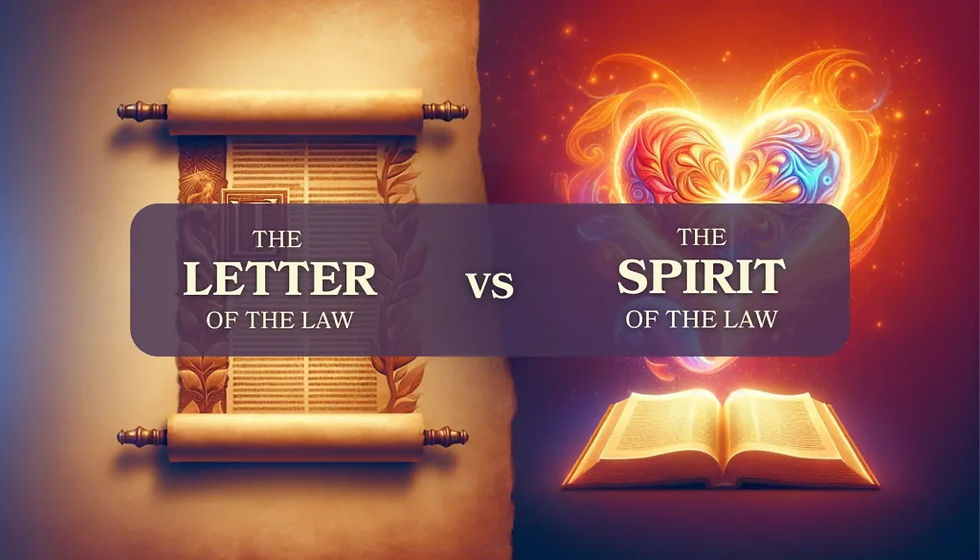
—————————-

Comments